

Contents
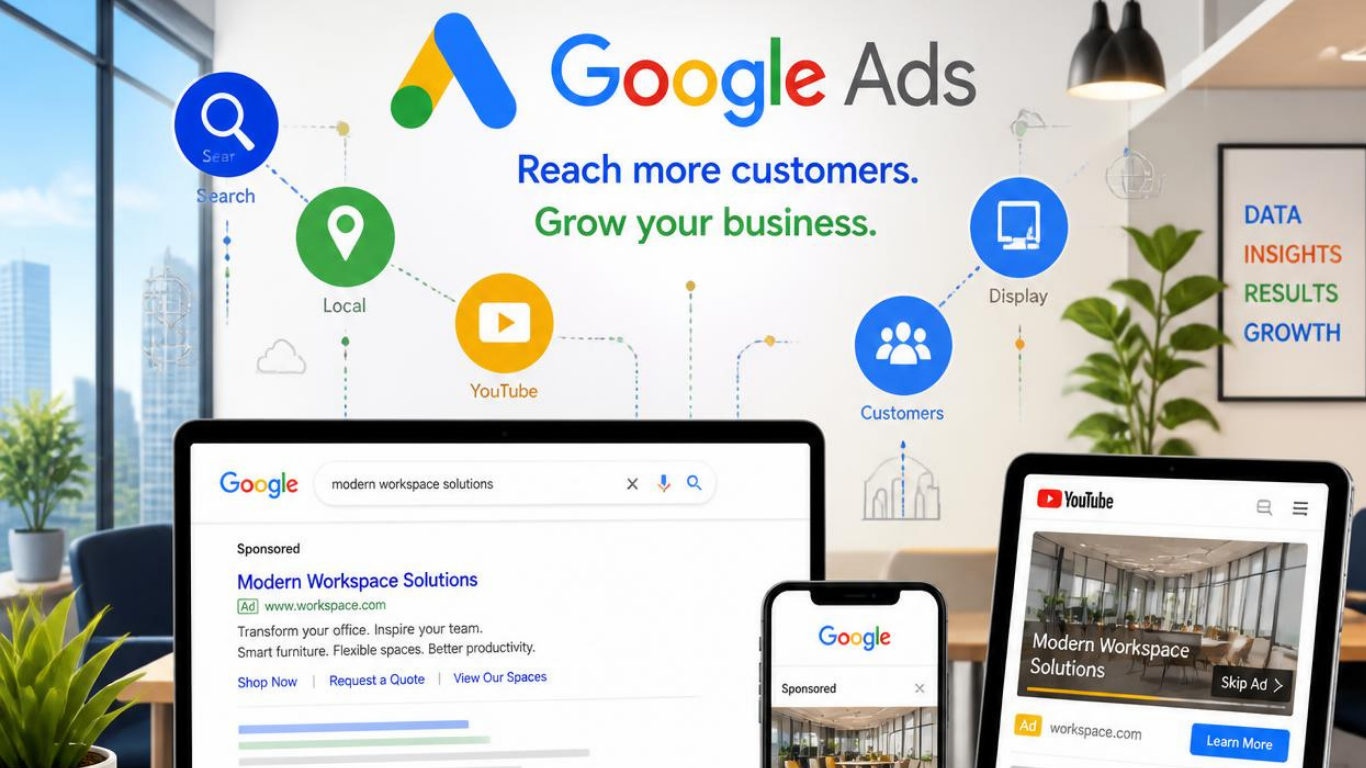
Google Ads: A Comprehensive Guide to Google's Advertising System
In a digital world where every second of user attention is precious, Google Ads is one of the most powerful marketing tools. It not only increases online visibility but also allows you to precisely reach potential customers. In this guide, we'll analyze the key aspects of Google Ads – from the basics to advanced campaign optimization strategies.
Google Ads, formerly known as Google AdWords, is an advertising platform that allows businesses to display ads both in Google search results and on partner websites. With advanced targeting options and a variety of ad formats, businesses can effectively reach their target audience, increasing their chances of conversion.
How does Google Ads work in practice?
Companies can tailor their campaigns to different business goals:
- Geotargeted ads – perfect for local businesses looking to attract customers from a specific area.
- Remarketing – an effective e-commerce strategy that allows you to reach users who visited the website but did not make a purchase.
- Product campaigns – promoting specific products in Google search.
- Video Ads – Increasing user engagement through video content on YouTube.
In an era of increasing online competition, effectively utilizing Google Ads can become a key element of your marketing strategy. Does your company already use this advertising system? Or are you considering implementing it? Regardless of your experience level, it's worth learning best practices that will help you maximize the platform's potential.
What is Google Ads and how does it work?
Google Ads is an advertising platform created by Google that allows businesses to promote their products and services in a variety of formats—from simple text ads, through engaging graphics, to dynamic videos and product ads. This allows businesses to effectively reach their target audience, which is crucial in online marketing.
The system works like an advertising auction, in which advertisers compete for selected keywords. However, the highest bidder doesn't always win – Google also considers the ad's quality and relevance to the user. This allows even smaller companies to effectively compete with larger players.
One of Google Ads' greatest strengths is its precise targeting. Advanced analytical tools allow you to tailor campaigns to specific user needs and behaviors, increasing ad effectiveness and conversion rates. Have you ever wondered how Google Ads can help your business grow?
Basic principles of Google Ads operation
Google Ads is based on several key principles that help you effectively manage your advertising campaigns:
- Advertising Auction – Ads are displayed based on an auction in which advertisers compete for selected keywords.
- Ad quality – the position of an ad is determined not only by the amount of the bid, but also by its relevance and quality in relation to the user’s query.
- Variety of formats – the system offers a wide selection of advertising formats, allowing you to tailor your message to your audience’s preferences.
In Google Ads, you can create campaigns in various formats:
- Text ads – appear in Google search results.
- Display ads – eye-catching on partner websites.
- Video ads – engage users on YouTube.
- Product ads – perfect for e-commerce.
This diversity gives you a greater chance of engaging users and capturing their attention. Which ad formats work best in your industry?
Where do Google Ads ads appear?
Google Ads can appear in a variety of places, increasing their reach and effectiveness. The most common locations are:
- Google search results – users actively search for information about products and services there.
- Partner websites – advertisements displayed within the Google advertising network.
- YouTube – video ads effectively attract user attention.
Thanks to its diverse display options, Google Ads allows you to reach potential customers at different stages of their purchasing journey. Do you already know which advertising channels best fit your marketing strategy?
Advantages of using Google Ads
Google Ads offers many benefits that can significantly impact your company's marketing success:
- Precise targeting – the ability to reach the right audience at the right time.
- Budget flexibility – control of expenses and adjustment of campaign costs to financial possibilities.
- Advanced analytical tools – ongoing monitoring of results and optimization of advertising strategy.
- Quick results – Google Ads campaigns can generate website traffic just a few hours after launch.
- Scalability – the ability to expand the campaign as the budget and company needs grow.
- Remarketing options – reach users who have already visited the site, increasing the chance of conversion.
- Integration with other Google tools – ability to synchronize campaigns with Google Analytics and Google Tag Manager.
- Multi-channel – ads can be displayed on Google Search, YouTube, Gmail and the Google Display Network.
- Competitiveness – the ability to compete with larger companies thanks to bidding strategy and campaign optimization.
- Access to local and global markets – the ability to target campaigns to both local and international customers.
In the digital age, online visibility is key to success. Is your company fully utilizing Google Ads' potential?
Types of Google Ads campaigns
Google Ads offers a wide range of campaign typesthat allow you to precisely reach your audience based on your marketing goals. Choosing the right ad format is crucial to the effectiveness of your promotional efforts, so it's worth understanding the available options and their applications.
Each type of Google Ads campaign has its own unique features that allow you to tailor your strategy to your specific business needs. You can choose from:
- text ads – reach users when they are actively searching for your products or services.
- Graphic campaigns on partner websites – increase brand awareness through visually appealing content.
- Product campaigns – present specific products with price and photo.
- Video campaigns – engage audiences on YouTube and the advertising network.
- App campaigns – increase the number of mobile app downloads.
- Performance Max – automated multi-channel campaigns optimized by AI.
Search campaign - text ads in Google results
Search campaigns are one of the most popular advertising formats in Google Ads. They allow you to display text ads directly in search results, meaning your offer reaches users exactly when they're searching for the products or services you offer.
Ads in this model are based on keywordsthat advertisers bid on to ensure their content appears in top positions. A proper bidding strategy and high-quality advertising can significantly increase brand visibility and conversions.
Display Network Campaign – graphic and text ads on partner websites
Display Network campaigns allow you to display image and text ads on websites that are part of the Google Display Network. They're a great way to reach a broad audience who consumes a variety of online content.
Ads in this model are great for:
- Building brand awareness – users see your ad while browsing websites.
- Engaging your audience – visually appealing content attracts attention.
- Precise targeting – ads can be targeted based on user interests and behavior.
Product campaign – ads with product information
Google Ads Shopping campaigns are an ideal e-commerce solution that allows you to promote specific products in search results and in the Shopping tab. These ads include product images, prices, and descriptions , making it easy for users to quickly compare offers.
With product campaigns you can:
- Reach people ready to buy – ads are displayed to users actively searching for products.
- Increase conversion – attractive product presentation encourages clicks.
- Improve your store visibility – your products appear in Google Shopping search results.
Video campaign - ads on YouTube and the Display Network
Google Ads video campaigns allow you to display video ads on YouTube and the Google Display Network. This dynamic format captures user attention and engages them in a way that traditional text or image ads struggle to achieve
Video ads are effective for:
- Building brand awareness – video attracts attention and is memorable.
- Communicating complex messages – video format allows for a better explanation of the offer.
- Precise targeting – ads can be targeted based on user demographics, interests and behavior.
App Promotion Campaign – Mobile App Ads
App campaigns are designed to increase downloads and user engagement with mobile apps. Ads can be displayed on Google Search, YouTube, and Google Play, ensuring broad reach.
Google uses advanced algorithms to optimize these campaigns, allowing you to:
- Maximizing installs – ads are targeted to users likely to download the app.
- Minimizing workload – the system automatically optimizes the campaign.
- Increased engagement – ads can encourage repeat app use.
Performance Max – automated multi-channel campaign
Performance Max is a modern Google Ads solution that uses machine learning to optimize your ads across Google channels. This allows you to achieve better results with less effort.
Performance Max integrates various ad formats and channels, allowing you to:
- Increased reach – ads appear in search, display networks, YouTube, Gmail and Google Maps.
- Automatic optimization – the system adjusts the campaign in real time.
- Maximize effectiveness – ads are targeted to users with the highest conversion potential.
Campaign optimization strategies and tools
In the world of online marketing, effective Google Ads campaign optimization is key to success. Properly selected strategies and tools not only increase ad visibility but also improve their effectiveness and return on investment. In this section, we'll discuss proven optimization methods—from remarketing to advanced analytics tools—that help maximize results.
Remarketing – reaching users again
Remarketing is one of the most effective strategies in Google Ads, allowing you to reconnect with people who have previously visited your website. This technique allows you to remind potential customers about your offer, increasing the chances of conversion.
The remarketing mechanism is based on:
- Tracking users using cookies.
- Displaying personalized adsthat encourage you to return to the site.
- Audience segmentation for precise targeting.
Precise targeting allows you to focus on people who have already shown interest in your products or services, making your campaigns more effective and generating a higher return on investment.
Google Shopping – product ads in the search engine
Google Shopping is a tool that allows you to display product ads directly in Google search results and in the Shopping tab. This allows users to quickly compare offers and make informed purchasing decisions.
Google Shopping ads include:
- Product photosthat attract attention.
- Prices, enabling quick comparison of offers.
- Descriptionsto help you make a purchasing decision.
Integrating Google Shopping with Google Ads allows for precise ad targeting, which is crucial for increasing e-commerce sales. This service allows you to reach users who are ready to buy, significantly increasing your chances of conversion.
Google Display Network – Google's advertising network
Google Display Network (GDN) is a comprehensive advertising network spanning millions of websites, apps, and platforms where Google Ads ads can be displayed. With GDN, you can reach a broad audience, which is crucial for building brand awareness and expanding campaign reach.
Google Display Network advertising can take many forms:
- Graphic – eye-catching banners.
- Text – effective in remarketing campaigns.
- Interactive – engaging users.
Precise targeting allows you to reach users most interested in your offer, which increases the effectiveness of your campaign.
Keyword planner – selecting the right phrases for your campaign
Keyword Planner is one of the most important tools in Google Ads, supporting the analysis and selection of appropriate keywords for advertising campaigns. It helps you identify keywords with the greatest potential, allowing you to more effectively reach the right audience.
Benefits of using Keyword Planner:
- Analysis of phrase popularity – checking how often they are searched.
- Selecting effective keywords – increasing the visibility of your ads.
- Budget optimization – selecting phrases with the best cost-to-effectiveness ratio.
Optimizing your campaigns for relevant keywords increases your ads' visibility in search results and improves their performance.
Conversion Tracking – Monitoring Ad Performance
Conversion tracking is an advanced analytics tool in Google Ads that allows you to measure campaign effectiveness by analyzing user actions after clicking on your ad. This feature allows you to pinpoint which elements of your campaign are generating the best results.
Conversion tracking features:
- Monitoring user activities – analysis of clicks, purchases, newsletter subscriptions.
- Campaign optimization – adapting the strategy to the behavior of recipients.
- Better budget management – investing in the most effective advertising.
Implementing conversion tracking allows you to optimize your campaigns on an ongoing basis, which is crucial for maximizing your return on investment.
Setting your bids and budget in Google Ads
Effectively managing Google Ads campaign costs is fundamental to success in online marketing. Simply setting a budget isn't enough—a strategic approach is crucial, allowing you to not only control expenses but also maximize your return on investment.
Google Ads offers a variety of bidding strategies that can be tailored to specific business goals. Choosing the right method is crucial to campaign effectiveness. Which strategy best fits your business model?
Target CPA – cost per conversion control
Target CPA (Cost Per Acquisition) is a solution for businesses that want to precisely manage their customer acquisition costs. Google Ads automatically optimizes bids to maximize conversions within a set budget.
The CPA model fits into the performance marketing strategy – you only pay for specific user actions, such as:
- purchase of the product,
- registration on the website,
- filling out the contact form.
This allows you to better allocate your budget and invest where it delivers the greatest value. Is Target CPA a strategy that will help you achieve your goals?
Target ROAS – Maximizing Return on Investment
Target ROAS (Return on Ad Spend) focuses on maximizing return on advertising spend. Google Ads analyzes data and dynamically adjusts bids to achieve a specific level of revenue relative to costs.
The ROAS model allows you to intelligently manage your spend by identifying the most profitable user interactions in real time. This allows you to focus on activities that generate the highest return on investment.
| Strategy | Main advantages |
|---|---|
| Target CPA | Precise control of conversion costs, payment for specific actions |
| Target ROAS | Maximizing revenues relative to expenses, dynamic rate optimization |
Is Target ROAS a strategy that will help you get more out of your advertising budget?
How to effectively manage your Google Ads campaign budget?
Effective budget management in Google Ads involves more than just determining spending amounts, but also, and above all, optimizing them. Regularly monitoring campaign results and adapting strategies based on the collected data is crucial.
To manage your budget effectively, it is worth:
- regularly analyze campaign results,
- test different budget strategies,
- adjust rates based on real data,
- respond to changing market conditions.
This approach allows you to quickly identify areas requiring optimization and maximize the effectiveness of your advertising efforts. Which budget management approach will work best for your campaign?
Certification and cooperation with Google Ads experts
In the dynamic world of online marketing, where competition is constantly growing, Google Ads certification is not only a prestigious distinction but, above all, an effective tool for campaign optimization. Programs such as Google Partner and Google Premier Partner allow agencies and specialists to validate their competencies and access advanced tools and technical support, which can significantly increase the effectiveness of advertising activities.
Becoming Google Ads certified is more than just a formality—it offers real business benefits. Working with certified experts allows companies to:
- better manage your advertising budget,
- increase campaign effectiveness,
- achieve a higher return on investment.
Could your business benefit from working with an experienced Google Ads specialist?
Google Partner – a certification program for agencies and specialists
The Google Partner Program was created for agencies and professionals who want to validate their skills in managing Google Ads campaigns. Participation provides access to:
- exclusive educational materials,
- training and webinars,
- technical support,
- the latest optimization tools.
Becoming a Google Partner not only demonstrates competence but also provides ongoing campaign optimization through access to the latest features of the Google advertising platform. This allows specialists to achieve better results for their clients and increase their competitiveness in the market.
Could your agency benefit from joining the Google Partner program?
Google Premier Partner – advanced level of certification
Google Premier Partner is the highest level of certification awarded to marketing agencies that achieve exceptional results in managing Google Ads campaigns. This status is confirmed by:
- advanced campaigning skills,
- extensive experience in advertising optimization,
- the ability to achieve above-average results.
Agencies with the Google Premier Partner title gain access to:
- even more advanced tools,
- dedicated technical support,
- opportunities to collaborate with Google experts.
This allows them to compete effectively in the market and attract customers looking for proven Google Ads experts.
Could achieving Google Premier Partner status help your agency further grow?
How to measure the effectiveness of Google Ads campaigns?
Precise analysis of Google Ads campaign performance is the foundation of any effective advertising strategy. The right tools and metrics not only help evaluate results but also enable optimization of activities to maximize return on investment. Which metrics are key, and how should you interpret them to make informed decisions?
Advertising Key Performance Indicators
To accurately assess the effectiveness of your Google Ads campaign, it's important to focus on key performance indicators (KPIs). These indicators indicate which elements of your campaign are performing best and where improvements are warranted.
| Indicator | Description |
|---|---|
| CTR (Click-Through Rate) | Click-through rate, which shows how often users click on an ad relative to its views. A high CTR indicates that the ad is relevant and engaging. |
| CPC (Cost Per Click) | Cost per click. This allows you to assess the effectiveness of your advertising budget – the lower the CPC while maintaining high-quality traffic, the better. |
| CPA (Cost Per Acquisition) | Cost per customer acquisition or conversion. A key metric for companies focused on sales or lead generation. |
| ROAS (Return on Ad Spend) | Return on advertising spend. This shows how much revenue each dollar spent on a campaign generates. |
| Conversion rate | The percentage of users who, after clicking on an ad, performed the desired action, e.g. made a purchase or signed up for a newsletter. |
Analyzing these metrics allows you to continually adjust your campaigns and eliminate ineffective activities. Which of these metrics are most important to you in the context of your advertising strategy?
Google Ads Audit – Campaign Analysis and Optimization
A regular Google Ads audit is an essential element of effective campaign optimization. It allows you to identify the strengths and weaknesses of your advertising efforts and implement changes to improve their effectiveness. The audit includes analysis of:
- Campaign structures – are campaigns logically organized and ad groups appropriately segmented to precisely reach audiences?
- Ad quality – is the ad content attractive, engaging and aligned with user intentions?
- Keyword selection – are keyword phrases well-matched to user queries and are irrelevant searches eliminated?
- Bidding strategy – is the budget being used effectively and bids optimally set to achieve the best results at minimal cost?
Conducting regular audits allows you to continually adjust your advertising strategy and maintain competitiveness. What elements of a Google Ads audit do you consider crucial to your campaign's success?
The most common mistakes and how to avoid them
Online marketing is prone to mistakes that can significantly reduce the effectiveness of advertising campaigns. In this section, we'll discuss the most common Google Ads pitfalls and show you how to avoid them so your ads run effectively and deliver real results.
Incorrect audience targeting
One of the most common mistakes in Google Ads campaigns is inaccurate audience targeting. Too broad or poorly selected a target audience means your ads reach people who aren't interested in what you offer. The result? Wasted budget and poor performance.
To avoid this, it is crucial to precisely define the target group, taking into account:
- Demographics – age, gender, social status.
- Interests – shopping preferences, hobbies.
- Location – regions where your offer has the greatest chance of success.
If you run an organic food store, focus on people who care about a healthy lifestyle instead of targeting random users. The more targeted your advertising, the greater the chance of effective ads and higher conversion rates.
Poorly selected keywords
Poor keyword selection is another pitfall that can undermine campaign effectiveness. Overly general keywords mean your ad reaches people who aren't even looking for what you offer, leading to low conversions.
To avoid this, it is worth using:
- Google Keyword Planner – a tool that helps you find the best-matching phrases.
- Long-tail phrases – more precise queries, e.g. instead of “sports shoes” it is better to use “women’s running shoes”.
- Negative keywords – eliminate unwanted searches, e.g. “free” for paid services.
This will ensure that your ad reaches people who are actually interested in purchasing it, which will increase the effectiveness of your campaign.
Insufficient campaign optimization
Failure to optimize regularly is a mistake that can prevent your ads from delivering the expected results. Many advertisers set up a campaign and leave it unchecked, failing to respond to changing market conditions.
To prevent this, it is worth:
- Monitor your results regularly – see which ads are performing best.
- Test different versions of your ads – compare the effectiveness of different headlines and content.
- Adjust your bids – increase your budget for more effective campaigns.
If you notice that one ad version generates more clicks than another, it's worth focusing your budget on the more effective variant. Optimization is key to success – experiment, analyze, and adjust your strategy to achieve the best results.
How much does advertising on Google Ads cost?
In the ever-increasing world of online marketing, understanding the costs of Google Ads campaigns. Prices can vary significantly depending on your industry, the level of competition, and your bidding strategy. It's important to understand what influences your cost-per-click and how to optimize your spending to maximize results with minimal investment.
Factors influencing the cost of a campaign
The cost of a Google Ads campaign is influenced by many factors, which can vary depending on the market and advertising strategy. The most important are:
| Factor | Cost impact |
|---|---|
| Competition | The more companies competing for the same keywords, the higher the cost per click. In industries like finance and insurance, rates can be exceptionally high. |
| Advertising quality | Google evaluates ads based on relevance and landing page quality. The better the quality, the lower the cost per click and the higher the ad's position. |
| Selection of keywords | The popularity and competitiveness of keywords directly impact costs. Properly selected keywords can increase campaign effectiveness while simultaneously reducing costs. |
| Targeting | Precisely defining the target group (e.g. location, age, interests) increases the effectiveness of the campaign, but may also affect its cost. |
Consciously managing these factors allows you to better control your budget and increase campaign effectiveness. Which of these elements has the greatest impact on your advertising costs?
How to optimize advertising spending?
Optimizing your Google Ads campaign costs isn't just about saving money, it's also about increasing your return on investment. Here are some effective methods to help you better manage your budget:
- A/B testing – Regularly comparing different versions of your ads allows you to find those that generate the best results at the lowest cost.
- Keyword optimization – Analyzing the effectiveness of phrases and eliminating those that generate high costs with low conversion allows you to better utilize your budget.
- Precise budget setting – Setting maximum bidding rates and a daily budget helps you avoid uncontrolled spending.
- Monitoring results – Regular data analysis and strategy adjustments based on campaign results allow you to continuously optimize your spending.
Effective budget management in Google Ads requires continuous analysis and a flexible approach to advertising strategy. Which optimization methods work best for your campaigns?
Google Ads advertising – on your own or with the help of an expert?
The decision to run a Google Ads on your own or with the help of a specialist can significantly impact your business's success. Each option has its advantages and disadvantages, so it's worth carefully analyzing which strategy best suits your needs.
Self-management of Google Ads campaigns
Many businesses, especially those on a tight budget, choose to manage their campaigns themselves to have complete control over their marketing efforts. Google Ads offers numerous tools and educational materials to help you learn and optimize your ads.
However, inexperience can lead to costly mistakes such as:
- Poorly selected keywords can generate traffic that does not result in conversions.
- Ineffective bidding strategies – may result in rapid budget exhaustion without the expected results.
- Improper ad configuration can reduce their effectiveness and visibility.
- As a consequence , the budget is spent without any conversion effects.
Collaboration with a Google Ads expert
Entrusting your campaign to certified specialists or agencies provides access to advanced analytical tools, proven strategies, and know-how. These experts can:
- Precisely target your ads, increasing their effectiveness.
- Analyze data and optimize campaigns in real time.
- Minimize the risk of errors, which translates into a better return on investment.
Additionally, working with professionals allows you to focus on growing your business instead of wasting time experimenting and learning through trial and error. And if we calculate our budget and costs correctly, assuming that our expert costs an average of 10% to 20% of the budget (commission), it may turn out that over the course of the entire monthly billing period, the expert will earn money for us and earn money for themselves (the commission depends on… the budget itself; it's worth negotiating rates here).
What to choose?
The final decision depends on several factors:
- Budget – can you afford an expert, or would you rather save money by learning on your own? (although with the above assumption, it's not a question of whether we can afford it, but whether we want to lose or earn more)
- Marketing goals – do you want a quick return on investment, or can you afford testing, experimenting and additional risk?
- Available resources – do you have the time and skills to effectively manage the campaign?
If you have the time and inclination, you can try your hand at Google Ads. However, if you want to maximize results and avoid costly mistakes, it's worth considering working with experts – contact usand you'll see that it's worth leaving this task to the experts.
Google Ads FAQ – Frequently Asked Questions and Answers
What is Google Ads?
Google Ads is an advertising platform that allows businesses to promote their products and services on Google search and partner websites.
How does Google Ads work?
Google Ads works on a bidding basis, where advertisers set bids per click (PPC – pay per click) or per ad display.
What are the main types of Google Ads campaigns?
Google Ads offers search campaigns, display campaigns, video campaigns, shopping campaigns, and app campaigns.
What is PPC?
PPC (pay per click) is an advertising model in which you only pay when a user clicks on your ad.
How much does advertising on Google Ads cost?
Advertising costs depend on the competition in your industry, your chosen keywords, and your campaign settings. You can set a daily budget and control your spending.
What are the benefits of using Google Ads?
Precise targeting, flexible budget, quick results, advanced analytical tools and remarketing options.
What are the targeting options in Google Ads?
Google Ads allows you to target users based on location, demographics, interests, and browsing history.
What is remarketing?
Remarketing is the strategy of re-displaying ads to users who have previously visited your website.
How can I measure the effectiveness of my campaign?
Google Ads offers advanced reporting and analytical tools, such as Google Analytics, that allow you to track conversions and campaign results.
What ad formats are available in Google Ads?
You can create text, image, video, and product ads tailored to different channels and audiences.
What is Quality Score?
Quality Score is Google's assessment of the quality and relevance of your ad, landing page, and keywords.
How to improve the performance of your Google Ads campaigns?
By optimizing your ad content, testing different keywords, improving your landing page, and analyzing your campaign results.
Is Google Ads effective for small businesses?
Yes, because Google Ads allows for precise targeting and flexible budget adjustments, which is beneficial for small businesses.
How long does it take to get results from a Google Ads campaign?
Ads can generate traffic within hours of launching a campaign, but optimal results depend on optimization and budget.
Can I stop the campaign at any time?
Yes, Google Ads allows you to pause, edit, or end your campaign at any time at no additional charge.
Write to us and learn how to effectively increase sales with Google Ads.
Read more about innovation in the digital world.