

Contents
What?
Modern online store design encompasses more than just appearance, but also the entire shopping journey: from navigation and product presentation to the shopping cart and checkout. Its goal is to simplify selection and shorten the purchase process, directly supporting sales and conversion.
Why?
Users evaluate a store in seconds. If a website is unreadable, chaotic, or looks outdated, customers often leave before they even see what's on offer. A polished online store design increases trust, organizes information, and removes obstacles to purchase, which increases conversions.
For whom?
For e-commerce owners and managers who want to better leverage store traffic, reduce cart abandonment, and improve results without increasing advertising budgets. Especially when traffic is high but sales aren't growing proportionally.
Background to the topic
E-commerce standards are changing rapidly: mobile devices dominate, and customers expect simplicity and speed. In this context, modern e-commerce design is becoming a necessity, as it impacts user experience, marketing effectiveness, and visibility on Google.
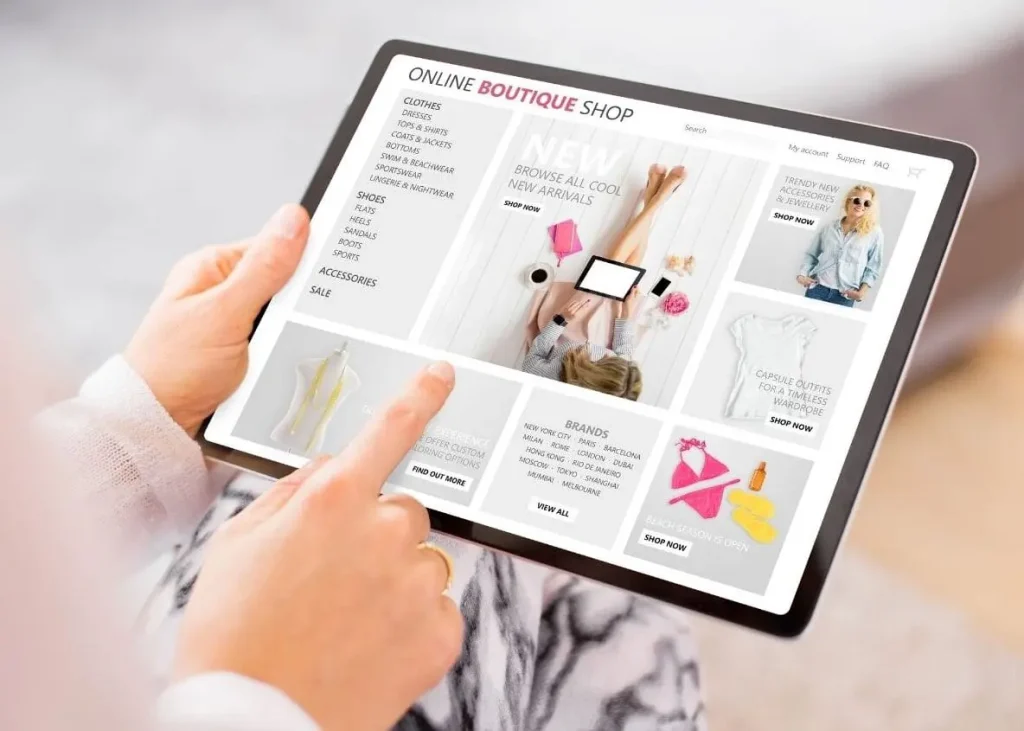
Modern online store design: how does it affect sales and conversion?
In the world of e-commerce, purchasing decisions are made faster than ever before. Users enter an online store with a specific need, but the design of the online store largely determines whether they stay, browse the offer, and complete the purchase. Aesthetics are no longer a sideline—they've become a sales tool that truly impacts conversion , basket value, and brand trust. If you want to look at this topic more broadly (beyond "pretty vs. ugly"), an approach based on measurable results and continuous optimization, such as e-commerce care , works well .
Modern e-commerce design is a combination of functionality, usability, and conscious visual communication. A well-designed store guides users through the shopping process naturally, without unnecessary obstacles or frustration. Every element—from the homepage layout, to the product page, to the checkout—is important and can boost or weaken sales. In practice, design often reveals content problems: illegible descriptions, unanswered customer questions, and chaotic messaging. Therefore, it's worth supporting design with well-thought-out content, for example, in the SEO Content Total, where content simultaneously drives visibility and purchase decisions.
Why does online store design have a direct impact on sales?
First impressions are formed in seconds. Users almost immediately assess whether a store looks professional, is easy to read, and inspires trust. If an online store's design appears chaotic or outdated, customers are unlikely to give it a second chance—even if the pricing is attractive. From a sales perspective, it's not just about "nice looks" that counts, but also how quickly it's understood: what you're selling, why it's worth it, and how easy it is to buy.
Modern design organizes information, shortens the time it takes to find a product, and reduces the number of decisions users must make. This reduction in cognitive effort is crucial for sales. The simpler and more intuitive the shopping path, the greater the likelihood of conversion. In practice, online store design influences the perceived credibility of a brand, the shopping experience, willingness to pay, and the user's return. These elements can be measured and then improved—and this is precisely where an approach based on cyclical implementations and data analysis, often visible in descriptions of activities and outcomes in the implementation.
UX and UI in e-commerce – the foundation of modern design
Although UX and UI often coexist, they are responsible for different aspects of the user experience. An online store's UX addresses the logic of the website's operation: category structure, the order of shopping steps, product filtering, and the clarity of information. UX determines whether the user feels guided through the store or must guess the next steps. If UX is underdeveloped, even an attractive UI won't save sales—the user will simply become discouraged.
The UI of an online store, on the other hand, is the visual layer—colors, typography, buttons, contrast, and graphic consistency. A modern UI isn't overwhelming, distracting, or competing with the content. Its purpose is to support purchasing decisions, not distract from the goal of making a purchase. Only a well-designed UX combined with a refined UI results in higher conversions —because the user sees, understands, and trusts what's happening on the site.
How does modern online store design lead users to purchase?
A modern online store operates like a well-designed process. Users intuitively know where to click, what information is most important to them, and what will happen next. They don't have to think, waste time searching for basic functions, or experience informational chaos. This is why design is no longer a matter of "taste"—it becomes a tool that shortens the path to purchase.
The product page is particularly important here. It's the place where the user makes a purchasing decision. A modern product page design highlights key information, reinforces sales arguments, and reduces distractions. Images, descriptions, price, availability, and calls to action must form a cohesive whole. If the product page doesn't answer customer questions (e.g., about delivery, returns, warranty), the user will look elsewhere for answers—often resulting in abandonment. Therefore, it's worth combining design with thoughtfully structured content that supports SEO and sales simultaneously, as in the SEO Content Total.
The checkout process plays a similar role. The simpler and more transparent the checkout process, the lower the risk of cart abandonment. Modern e-commerce design shortens forms, eliminates unnecessary steps, and clearly communicates the user's current stage. In many stores, the greatest sales "leakage" occurs here—therefore, checkout optimization should be an ongoing process, not a one-time change. In practice, this works best as part of ongoing store maintenance, for example, in e-commerce maintenance, where improvements are implemented based on data and user behavior.
Design elements that actually increase conversion
- clear page structure and logical navigation,
- responsive online store design adapted to mobile,
- clear CTAsthat don't get lost in the layouts,
- page loading speed,
- trust-building elements (reviews, delivery information, security).
Each of these elements may seem minor on its own, but together they create an environment in which the user feels confident and comfortable. Comfort and trust are often the deciding factors in whether a customer moves from "viewing" to "buying." If you want these elements to be refined and developed over time, a good approach is to work with a continuous optimization model, rather than a one-time "design.".
Online Store Design, SEO, and Long-Term Growth
It's worth emphasizing that modern online store design affects not only conversionsbut also search engine visibility. Google increasingly rewards sites that offer a good user experience. Loading speed, responsiveness, a clear structure, and time spent on the page are all signals of quality. When design is well-thought-out, users are more likely to browse categories, read descriptions, and navigate between products—which also enhances SEO results.
A store designed with UX principles in mind has a lower bounce rate, generates longer sessions, leverages organic traffic, and more effectively supports SEO efforts and paid campaigns. If you want your website to not only look good but also perform well for Google and sales, it's worth combining design with regular content creation and optimization. In practice, this supports the Total Content SEO, where content is planned based on user intent, not random phrases.
Comparison: outdated design vs. modern online store design
| Area | Outdated shop | Modern design of the online store |
|---|---|---|
| Structure | Chaotic | Logical and predictable |
| Mobile | Difficult operation | Mobile First Project |
| Product card | Little information | Focused on the purchasing decision |
| Checkout | Complex | Short and intuitive |
| Trust | Low credibility | A consistent, professional image |
| Conversion | Low | Clearly higher |
When is an online store redesign a real investment?
Redesign isn't an aesthetic expense, but a business decision. If a store generates traffic but sales stagnate, the problem often isn't the offering, but the online store design, which doesn't support the user's decision-making process. It also happens that a store "stagnates" due to limitations in category structure, filtering, or product page communication—all areas that can be improved without completely disrupting the business.
In such situations, a design change improves traffic efficiency, increases sales without increasing advertising budgets, strengthens brand image, and prepares the store for further growth. The best results are achieved with a redesign based on data (not just visual preferences) and phased implementations to quickly gather insights and improve subsequent elements. This approach is particularly effective in providing ongoing support, such as e-commerce support, where store development is a process, not a one-time event.
What do you need to know?
Modern online store design has a real impact on sales and conversionsbecause it simplifies the shopping process, strengthens trust, and improves the user experience. It's not a trend or a matter of taste, but one of the key elements of effective e-commerce. A store designed with the user in mind sells more—and does so in a repeatable and scalable way.

Marcin Stadnik
e-commerce advisor
The author is a manager with extensive experience in e-commerce, sales strategy, and content marketing. He is a digital practitioner and consultant with over 15 years of experience in e-commerce projects, sales strategy, and online business development, as well as 25 years of experience in broadly defined distribution (offline and online). He specializes in creating and implementing effective solutions for online stores, supporting companies in developing their digital presence. He co-creates appropriate strategies for e-businesses, conducts audits, and oversees marketing activities—always combining analytical knowledge with market practice. He is the author and co-author of content published on the swiatcyfrowy.pl website—based on his many years of consulting, analytical, and operational experience. The materials created are intended to provide reliable, valuable knowledge that truly supports the development of online businesses. The content here is designed to address the real challenges and needs of companies operating in the e-commerce environment (the digital world).